
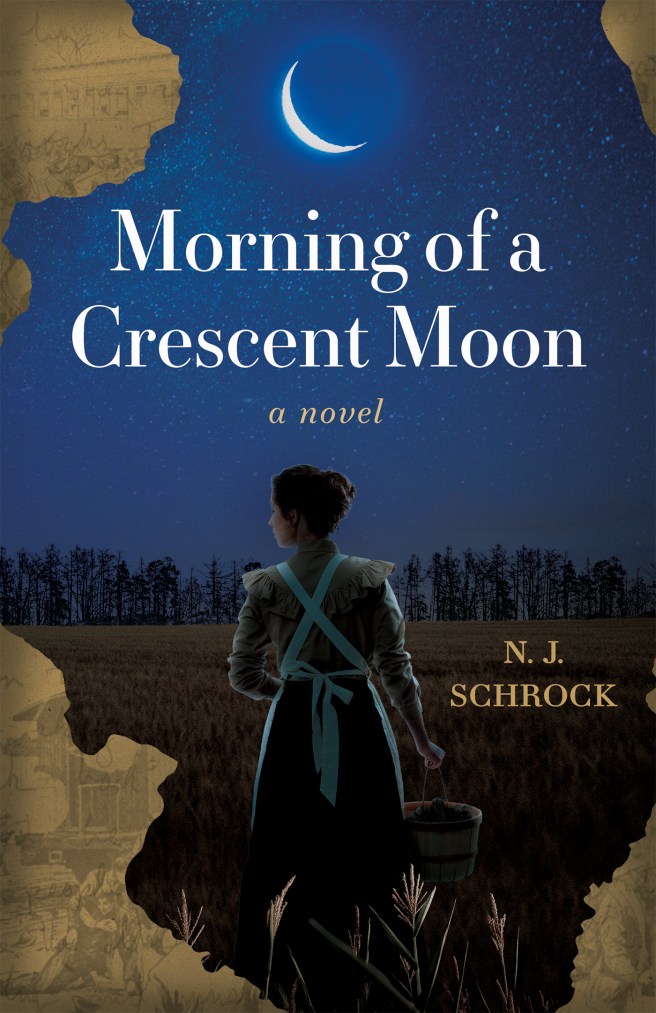
In Morning of a Crescent Moon, the novel opens with an aeronaut flying a balloon over the town of Virden, Illinois, on August 1, 1898.
“Hovering above the earth, an aeronaut enjoyed the isolation afforded by a modern, lighter-than-air craft, a basket suspended under a bubble of silk spun by worms and filled with hydrogen gas. The balloon allowed its occupant to become a creature of the sky, leaving behind its humble beginnings to commune with the clouds…”
I describe how the clouds part, and the town of Virden is revealed. The wind carries the balloon along railroad tracks, and readers gain a high-level view of the town’s layout. A thunderhead builds in the south, while the balloon gradually loses altitude. A train approaches, and the aeronaut begins to see the passengers. Then the scene cuts to inside the train and the passengers arriving in Virden.
Initially, I began with the aeronaut scene to give readers an understanding of the town’s layout, but the scene became much more than that. It became a metaphor for what we do when we write or read historical fiction. We’re sitting in the present, trying to view the past, but we can do so only from a thousand feet or higher unless we have personal journals that reveal the interiorities of history’s participants. For the Battle of Virden, we have newspaper accounts, summary articles, and a few pages of Alexander Bradley’s memoir. I’ve read those, studied the 1894 and 1900 Sanborn maps of the town layout, and pored over the 1900 census, but those don’t tell the whole story. The newspaper pages contain snippets of what was happening in the town, yet they remain isolated pieces of information until they are placed in context and brought together like pieces of a jigsaw puzzle.
I began my “descent” to ground level, Virden 1898, by reading microfilm images of The Virden Reporter, and I noticed how the Local News page contained brief items like this one: “Judge and Mrs. Balfour Cowen are having their residence in Virden fixed up a little preparatory to moving here from Carlinville. Their many Virden friends will welcome them back.” After reading months of issues and discovering hard copies of a second Virden newspaper, The Virden Record, and poring over it, these pieces of information began fitting together into a picture of the town during a historic event. I came to understand who the people were and what was going on in their lives. Nell Furry married Judge Herbert Cowen [son of Balfour] at the Furry home because the Presbyterian church was being renovated. Almira Henderson married Howard T. Willson and had the wedding of the season. A woman discovered a tarantula in the bananas at Lorton’s grocery store. (Imagine how shocked an Illinois woman would be to see a tarantula crawl out of bananas!) Band concerts were held every Saturday night, and I know what was played. As September waned and October approached, hundreds of out-of-town coal miners began arriving in Virden to support the Virden miners. All of these events are facts reported in the town’s two newspapers.
What isn’t reported is what was going on in the heads and hearts of the residents. The lived experience of being in Virden, Illinois, in 1898 is the ground level, and it had to be imagined. By placing imagined people—including their hopes and fears—within this context, I wanted to touch readers’ hearts and affect a broader audience than if I had simply written a summary of what was already known.
I wrote the Battle of Virden as historical fiction so readers would experience this historical event, understand what the miners were fighting for, and perhaps gain an appreciation for similar struggles that are still being fought today. Yes, I had to invent details that I didn’t know, but as long as I kept the details consistent with what is known about Virden in 1898, they help readers imagine these lives removed from us today by more than one hundred and twenty-five years. Readers descend to ground level from the thousand-foot view, if only briefly. At the end of the novel, the aeronaut makes another appearance and rises out of 1898 and the town of Virden, Illinois, as we readers do when we turn the last page.
I just finished reading Sophronia Scott’s Wild, Beautiful, and Free, a historical fiction novel set before and during the Civil War. I’ve read history books, academic articles, and newspaper accounts of that time period, but those are not going to make me experience the life of an enslaved person. For someone like me, a white woman living in the twenty-first century, a novel like this one helps put my feet on the ground and into the skin of an enslaved mulatto woman, seeking freedom in the 1860s. Sophronia Scott accomplished that in Wild, Beautiful, and Free.
In Morning of a Crescent Moon, I hope that readers gain insight into what living in Virden, Illinois, was like in 1898, what the coal miners were fighting for, and what counted as a victory. The forces that miners resisted then remain active today. By better understanding the struggles in 1898 and how their victories were won, we can continue the fight for basic labor rights here, at ground level, in the twenty-first century.
 N. J. Schrock
One thought on “Why Historical Fiction?”